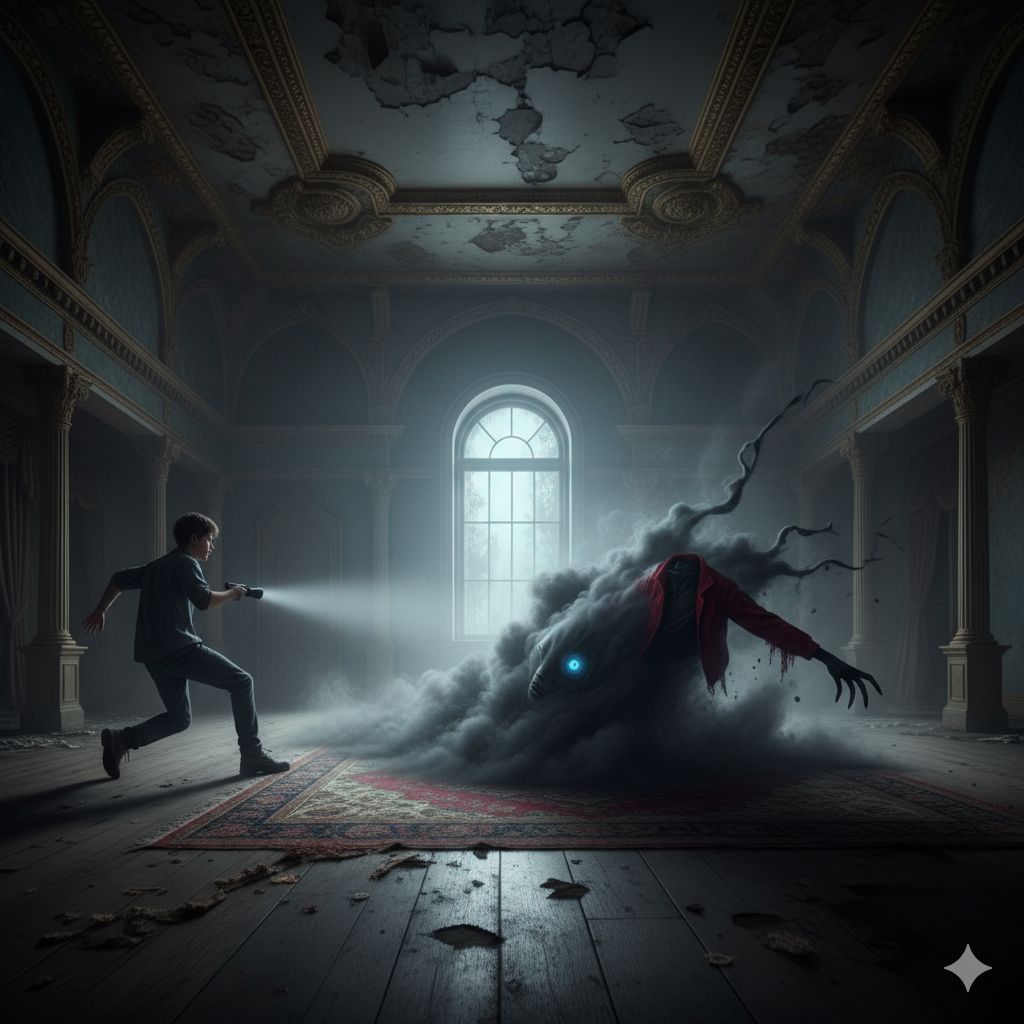
The old Willows estate had stood empty for twenty years, its decaying Victorian architecture shrouded in the perpetual gloom of the surrounding woods. But it wasn’t the dust or the creaking floorboards that kept people away; it was the legend of the Morphos, the shapeshifting ghost.
Liam, a young urban explorer with a flair for the dramatic and a powerful disregard for local legends, had finally broken in. The air inside was thick and cold, smelling of mildew and forgotten things. He set up his camera gear in the grand, decaying ballroom, its once-gilded ceiling now peeling like sunburnt skin.
He’d heard the stories: the Morphos wasn’t a sheet-wearing phantom or a translucent specter. It was a reflection of the deepest fear, a mimic of the most beloved memory, an inversion of reality itself.
———————————————————————-
The First Encounter: The Familiar Terror
Liam settled into a moldy armchair, reviewing the empty footage. A faint sound, like dry leaves skittering across wood, drifted from the hallway.
“Showtime,” he muttered, grabbing his flashlight.
He reached the hallway. There, standing silhouetted against the weak moonlight filtering through a grimy window, was not a ghost, but Sarah.
Sarah. His childhood best friend. The one who had moved away without a word, leaving a gaping, inexplicable hole in his life. She looked exactly as he remembered her at age ten—the bright red jacket, the missing front tooth, the innocent, eager eyes.
“Liam?” she whispered, her voice carrying the pure, bell-like clarity he hadn’t heard in two decades.
A wave of dizzying relief washed over him, followed instantly by a colder, sharper realization: Sarah was not here.
The figure took a hesitant step toward him, its small hand lifting in a gesture of welcome. But as it moved, the moonlight caught the edge of its outline. It wasn’t solid. The line where her cheek met the darkness wavered, blurring like an oil slick on water. Her small, innocent hand seemed to stretch, her fingers elongating into thin, black spindles.
He raised his flashlight, flooding the hallway. The spectral Sarah didn’t vanish—it shivered. The red jacket became a tattered, crimson shroud. The face dissolved, the eyes remaining as twin pinpricks of icy blue light, centered in a swirling vortex of gray mist.
It wasn’t Sarah. It was the memory of a lost friend twisted into a nightmare, a mocking, unstable imitation.
Liam scrambled backward, tripping over a rug. The mist-thing lunged, dissolving its child-shape entirely, becoming a low, rushing cloud that flowed toward him like a tide of shadow.
———————————————————————-
The Chase: The Walls Themselves
He bolted up the main staircase, his heart hammering against his ribs. Behind him, the swirling cloud flowed, but it wasn’t flowing fast enough. It was taking its time, observing him.
He reached the landing. The banister beneath his hand was suddenly warm, familiar. He looked down. The ornate, carved wood was gone. He was gripping a cold, stainless steel rail.
The landing had become the balcony of his own childhood bedroom. The wallpaper was the faded dinosaur pattern he remembered. His collection of comic books sat neatly on a shelf.
Stop it! he screamed internally. The Morphos was playing with his mind, trying to make the house feel safe, only to betray him.
He heard the shadow-mist pooling at the base of the illusory staircase. The ceiling fan (which wasn’t there five seconds ago) began to whir slowly.
Clang! Clang! Clang!
The rhythmic, piercing sound of a metal baseball bat hitting asphalt echoed from the end of the fake hallway. It was the sound his estranged father made practicing late at night—a sound that always meant he was home and angry.
The wall to his right rippled. It bulged, stretching taut, and then split open, revealing a gaping, black maw. The maw wasn’t a doorway; it was the face of the ghost itself, now too large to define, its edges seeping into the structure of the house.
It hadn’t just imitated his memory; it had inhabited the architecture, turning the Willows estate into a physical manifestation of his deep-seated psychological wounds.
———————————————————————-
The Revelation: The Final Form
Liam ran, not caring where he was going. He burst through a door and found himself in the estate’s disused kitchen. The smell of rust and rot was instantly replaced by the faint, comforting scent of his grandmother’s apple pie.
He stopped, momentarily paralyzed by the deceptive, nostalgic sensory assault.
The black maw-wall from the hallway didn’t follow him. Instead, the Morphos took its final, most chilling form.
The smell of apple pie intensified. In the center of the kitchen, the air shimmered, the light bending violently. It began to take shape—not of a person, or a shadow, or a wall—but of an idea.
It became a perfect reflection of his own face, hanging suspended in the air. Not Liam as he was now, but Liam’s idealized self: unburdened, happy, successful, and content. The face was smiling, the eyes serene.
Then, the spectral reflection opened its mouth, and spoke in his own voice, but utterly devoid of human warmth:
“Why run from me? I am all you want. I am all you could be. And I am what you fear you will never be.”
The spectral face began to sink into his own chest, the boundary between the ghost-form and Liam’s body dissolving. The shapeshifter’s ultimate form was the usurpation of the self—to become the living person, leaving behind only an empty shell animated by the Morphos’s terrifying awareness.
Liam didn’t fight with his fists or his flashlight. He fought with defiance. He focused not on the idealized face, but on the dust, the rot, the reality of the Willows estate.
“You’re a lie!” he shouted, throwing his camera rig at the ethereal face.
The illusion fractured. The idealized face screamed, a sound like shattering glass and grinding teeth. It recoiled violently, shedding the perfect features and collapsing into its true, unstable state: a column of formless, roiling black smoke.
The smoke rushed through the windowpane without breaking the glass, fleeing the kitchen in a silent, desperate retreat.
Liam stood alone, his heart pounding a frantic rhythm against the phantom pressure on his chest. He looked at the window where the smoke had vanished. The glass was whole.
He didn’t wait. He didn’t check the footage. He stumbled out of the Willows estate and didn’t look back.
The Morphos, the shapeshifting ghost, had not succeeded in possessing him, but it had accomplished something far more insidious: it had shown him his own truth, using the architecture of his soul as its gruesome canvas. And as Liam drove away, he swore he saw a fleeting image in his rearview mirror—not of a shadow, but of his own face, turning slightly, with a smile that was not quite his own.
 Ny's Writing Blog ✍️
Leave a comment