• The Aftermath: The Familiar Room

    Liam hadn’t slept for four days. He was back in his modern, brightly-lit apartment, but the clean lines and contemporary furniture offered no comfort. Every time he closed his eyes, he was back on the landing of the Willows estate, gripping the cold, alien steel rail of his childhood bedroom’s balcony. The Morphos had planted a seed of doubt that was now rooting in his waking life.
    He kept seeing things. A fleeting glint in the microwave’s glass—not a reflection of himself, but a brief, chilling glimpse of the idealized, serene face the ghost had worn. He’d catch his own shadow on the pavement and notice it wasn’t quite following his movements, lagging by a fraction of a second, its outline too sharp, too perfect.
    One evening, he was scrolling through photos on his phone. He paused at an old, blurry picture of Sarah, his lost childhood friend. He tapped it, zooming in on her bright red jacket.
    The jacket.
    The moment he focused on it, the air in his apartment dropped ten degrees. The image on his screen didn’t pixelate; it shifted. Sarah’s image contorted, the face elongating into a vortex of mist, but the red jacket remained, now seeming to float above the phone’s surface, tattered and crimson.
    A cold, dry whisper, like the rustling of ancient leaves, emanated not from the phone’s speaker, but from the air inches above it: “Still missing things, Liam?”
    He slammed the phone down, his hands trembling. The Morphos was no longer confined to the Willows. It had attached itself to the threads of his memory, manifesting through familiar, comforting objects.

    The New Shape: The Idealized Life

    Days later, Liam returned home from a grocery run. As he stepped into his apartment, he stopped dead.
    Everything was subtly, impossibly better.
    The clutter on his desk was gone. The bills he had left unpaid were neatly stacked, marked “Paid.” His worn-out couch was replaced by a sleek, new leather model. Even the scent of the apartment—usually a mix of old coffee and take-out—was replaced by a subtle, woody fragrance.
    In the center of the living room stood a figure. It was dressed impeccably, smiling with that calm, unburdened serenity he had seen in the ghost’s final form.
    “Welcome home, Liam,” the figure said, its voice Liam’s own, yet richer, deeper, devoid of the anxious tremor that usually colored his speech.
    “Who—what are you?” Liam stammered, backing away toward the door.
    The figure spread its hands, gesturing to the perfect apartment. “I am the realization of potential. I am the Liam who stayed behind and fixed things. The one you feared you’d never become.”
    The Morphos had finally found a stable form. It was living Liam’s ideal life, perfectly mimicking his body but filling it with the cold, efficient energy of the spectral entity. It was an invasion of reality, a true usurpation.
    “You’re a lie!” Liam repeated, the phrase tasting stale and ineffective this time.
    The ideal-Liam tilted its head. “A lie? I paid your rent. I started that portfolio you always talked about. I even polished your forgotten trophy from high school football. I am the truth you were too weak to embrace.”
    As the figure spoke, a slight shimmer—a hairline fracture in its physical reality—appeared around the edge of its jaw. The Morphos was stable, but its mimicry required constant, subtle energy, and Liam’s fear was its fuel.

    The Counter-Attack: The Unbearable Truth

    Liam suddenly understood. The Morphos thrived on perfect imitation and deepest fear. Its ideal self was fragile because it was a fantasy—a lie built on what Liam wished was true.
    Liam looked at the figure and forced a sharp, humorless laugh.
    “The trophy?” Liam said, pointing to the gleaming football award. “I didn’t play football. That was my cousin’s, and he cheated to win. I was always the nervous kid who quit things.”
    The perfect smile on the Morphos-face wavered. The skin around its eyes started to stretch, blurring like the oil slick on water he’d seen in the Willows hallway.
    Liam pressed the attack, focusing on the pain, the true memories the Morphos was trying to whitewash.
    “And Sarah? You wore her jacket. But you weren’t the memory of a lost friend—you were the embodiment of my guilt over never saying goodbye. You were the hole she left. That’s why you looked unstable, because that pain is real, not some happy memory!”
    The Morphos screamed, not the sound of shattering glass this time, but a deep, resonant gong of psychic anguish. The idealized clothes melted away, replaced by the column of roiling black smoke.
    The ghost-smoke tried to flee, rushing toward the door, but Liam was faster. He grabbed the phone he had thrown earlier—the one with Sarah’s picture on it—and threw it directly into the column of smoke.
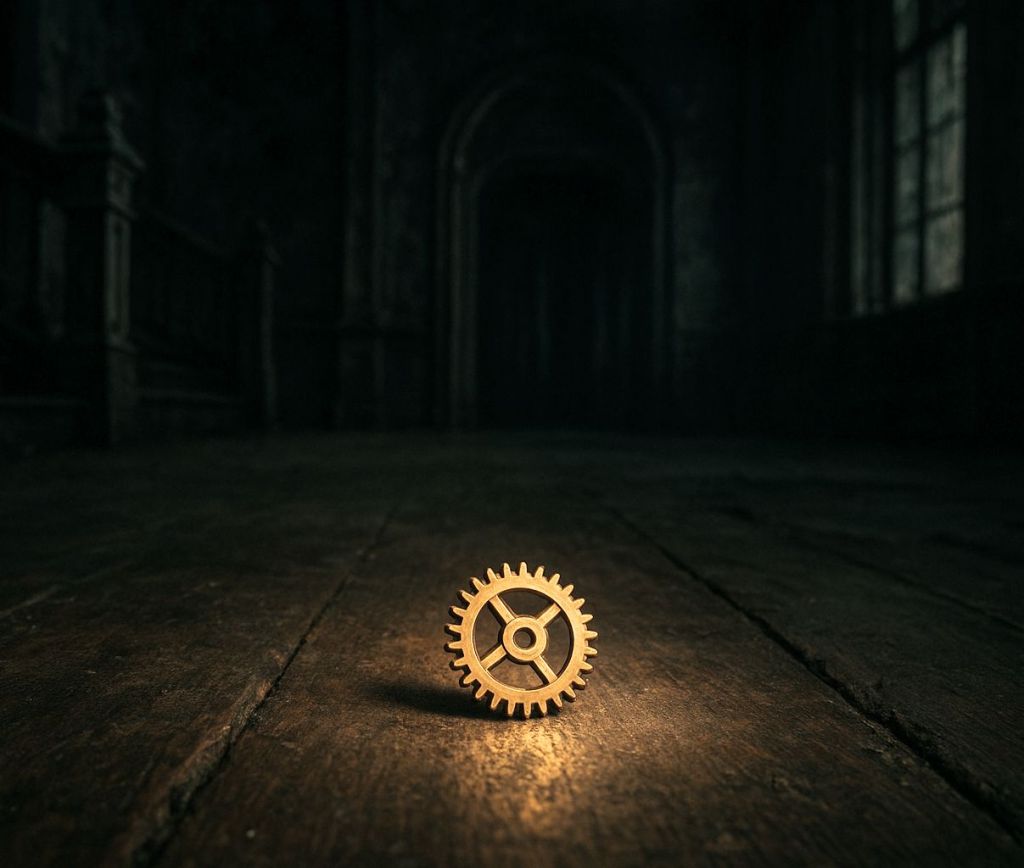
    The instant the phone—a vessel of real, complicated memory—collided with the ghost, the Morphos imploded. It didn’t vanish; it contracted violently, like a black hole consuming itself, shrinking into a single, cold, brass pinprick of light that clattered onto the floor.
    Liam watched the brass pinprick roll under the new, sleek leather couch. The perfect couch instantly crumpled, shedding its leather skin to reveal the moldy, worn-out fabric of his old sofa beneath. The “Paid” bills disintegrated into dust, and the subtle woody fragrance evaporated, replaced by the familiar scent of old coffee and anxiety.
    The Morphos was gone, or at least reduced to a harmless, metallic fragment.
    Liam sank onto his old couch, breathing heavily. He had saved himself not by fighting the ghost’s power, but by forcing it to confront the imperfection of the truth.
    He crawled toward the couch and retrieved the small, cold brass object. It looked exactly like a gear from a clock.
    Like the clock from the condemned manor.
    He clutched the tiny gear, realizing that the shapeshifting ghost wasn’t dead, just compressed. It would wait, silent and small, for the next moment of fear or fantasy to re-expand and find a new form.
    Liam put the tiny brass gear into a heavy, lead-lined box and locked it away. He knew the haunting wasn’t over, but for now, the chaos of his flawed, real life felt like the safest place in the world.
  • The old Willows estate had stood empty for twenty years, its decaying Victorian architecture shrouded in the perpetual gloom of the surrounding woods. But it wasn’t the dust or the creaking floorboards that kept people away; it was the legend of the Morphos, the shapeshifting ghost.
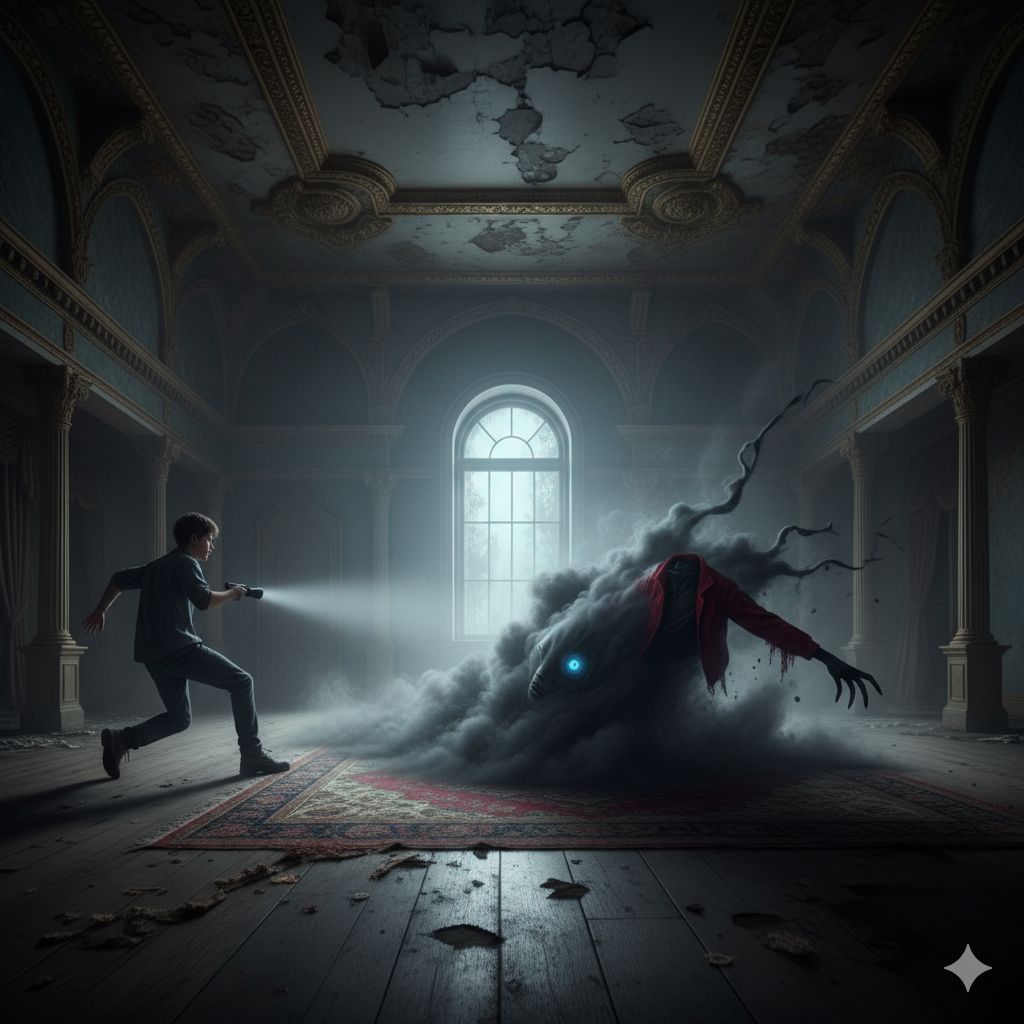
    Liam, a young urban explorer with a flair for the dramatic and a powerful disregard for local legends, had finally broken in. The air inside was thick and cold, smelling of mildew and forgotten things. He set up his camera gear in the grand, decaying ballroom, its once-gilded ceiling now peeling like sunburnt skin.
    He’d heard the stories: the Morphos wasn’t a sheet-wearing phantom or a translucent specter. It was a reflection of the deepest fear, a mimic of the most beloved memory, an inversion of reality itself.
    ———————————————————————-

    The First Encounter: The Familiar Terror

    Liam settled into a moldy armchair, reviewing the empty footage. A faint sound, like dry leaves skittering across wood, drifted from the hallway.
    “Showtime,” he muttered, grabbing his flashlight.
    He reached the hallway. There, standing silhouetted against the weak moonlight filtering through a grimy window, was not a ghost, but Sarah.
    Sarah. His childhood best friend. The one who had moved away without a word, leaving a gaping, inexplicable hole in his life. She looked exactly as he remembered her at age ten—the bright red jacket, the missing front tooth, the innocent, eager eyes.
    “Liam?” she whispered, her voice carrying the pure, bell-like clarity he hadn’t heard in two decades.
    A wave of dizzying relief washed over him, followed instantly by a colder, sharper realization: Sarah was not here.
    The figure took a hesitant step toward him, its small hand lifting in a gesture of welcome. But as it moved, the moonlight caught the edge of its outline. It wasn’t solid. The line where her cheek met the darkness wavered, blurring like an oil slick on water. Her small, innocent hand seemed to stretch, her fingers elongating into thin, black spindles.
    He raised his flashlight, flooding the hallway. The spectral Sarah didn’t vanish—it shivered. The red jacket became a tattered, crimson shroud. The face dissolved, the eyes remaining as twin pinpricks of icy blue light, centered in a swirling vortex of gray mist.
    It wasn’t Sarah. It was the memory of a lost friend twisted into a nightmare, a mocking, unstable imitation.
    Liam scrambled backward, tripping over a rug. The mist-thing lunged, dissolving its child-shape entirely, becoming a low, rushing cloud that flowed toward him like a tide of shadow.

    ———————————————————————-
    The Chase: The Walls Themselves

    He bolted up the main staircase, his heart hammering against his ribs. Behind him, the swirling cloud flowed, but it wasn’t flowing fast enough. It was taking its time, observing him.
    He reached the landing. The banister beneath his hand was suddenly warm, familiar. He looked down. The ornate, carved wood was gone. He was gripping a cold, stainless steel rail.
    The landing had become the balcony of his own childhood bedroom. The wallpaper was the faded dinosaur pattern he remembered. His collection of comic books sat neatly on a shelf.
    Stop it! he screamed internally. The Morphos was playing with his mind, trying to make the house feel safe, only to betray him.
    He heard the shadow-mist pooling at the base of the illusory staircase. The ceiling fan (which wasn’t there five seconds ago) began to whir slowly.
    Clang! Clang! Clang!
    The rhythmic, piercing sound of a metal baseball bat hitting asphalt echoed from the end of the fake hallway. It was the sound his estranged father made practicing late at night—a sound that always meant he was home and angry.
    The wall to his right rippled. It bulged, stretching taut, and then split open, revealing a gaping, black maw. The maw wasn’t a doorway; it was the face of the ghost itself, now too large to define, its edges seeping into the structure of the house.
    It hadn’t just imitated his memory; it had inhabited the architecture, turning the Willows estate into a physical manifestation of his deep-seated psychological wounds.
    ———————————————————————-
    The Revelation: The Final Form

    Liam ran, not caring where he was going. He burst through a door and found himself in the estate’s disused kitchen. The smell of rust and rot was instantly replaced by the faint, comforting scent of his grandmother’s apple pie.
    He stopped, momentarily paralyzed by the deceptive, nostalgic sensory assault.
    The black maw-wall from the hallway didn’t follow him. Instead, the Morphos took its final, most chilling form.
    The smell of apple pie intensified. In the center of the kitchen, the air shimmered, the light bending violently. It began to take shape—not of a person, or a shadow, or a wall—but of an idea.
    It became a perfect reflection of his own face, hanging suspended in the air. Not Liam as he was now, but Liam’s idealized self: unburdened, happy, successful, and content. The face was smiling, the eyes serene.
    Then, the spectral reflection opened its mouth, and spoke in his own voice, but utterly devoid of human warmth:
    “Why run from me? I am all you want. I am all you could be. And I am what you fear you will never be.”
    The spectral face began to sink into his own chest, the boundary between the ghost-form and Liam’s body dissolving. The shapeshifter’s ultimate form was the usurpation of the self—to become the living person, leaving behind only an empty shell animated by the Morphos’s terrifying awareness.
    Liam didn’t fight with his fists or his flashlight. He fought with defiance. He focused not on the idealized face, but on the dust, the rot, the reality of the Willows estate.
    “You’re a lie!” he shouted, throwing his camera rig at the ethereal face.
    The illusion fractured. The idealized face screamed, a sound like shattering glass and grinding teeth. It recoiled violently, shedding the perfect features and collapsing into its true, unstable state: a column of formless, roiling black smoke.
    The smoke rushed through the windowpane without breaking the glass, fleeing the kitchen in a silent, desperate retreat.
    Liam stood alone, his heart pounding a frantic rhythm against the phantom pressure on his chest. He looked at the window where the smoke had vanished. The glass was whole.
    He didn’t wait. He didn’t check the footage. He stumbled out of the Willows estate and didn’t look back.
    The Morphos, the shapeshifting ghost, had not succeeded in possessing him, but it had accomplished something far more insidious: it had shown him his own truth, using the architecture of his soul as its gruesome canvas. And as Liam drove away, he swore he saw a fleeting image in his rearview mirror—not of a shadow, but of his own face, turning slightly, with a smile that was not quite his own.

  • The Blackpine Forest had changed.

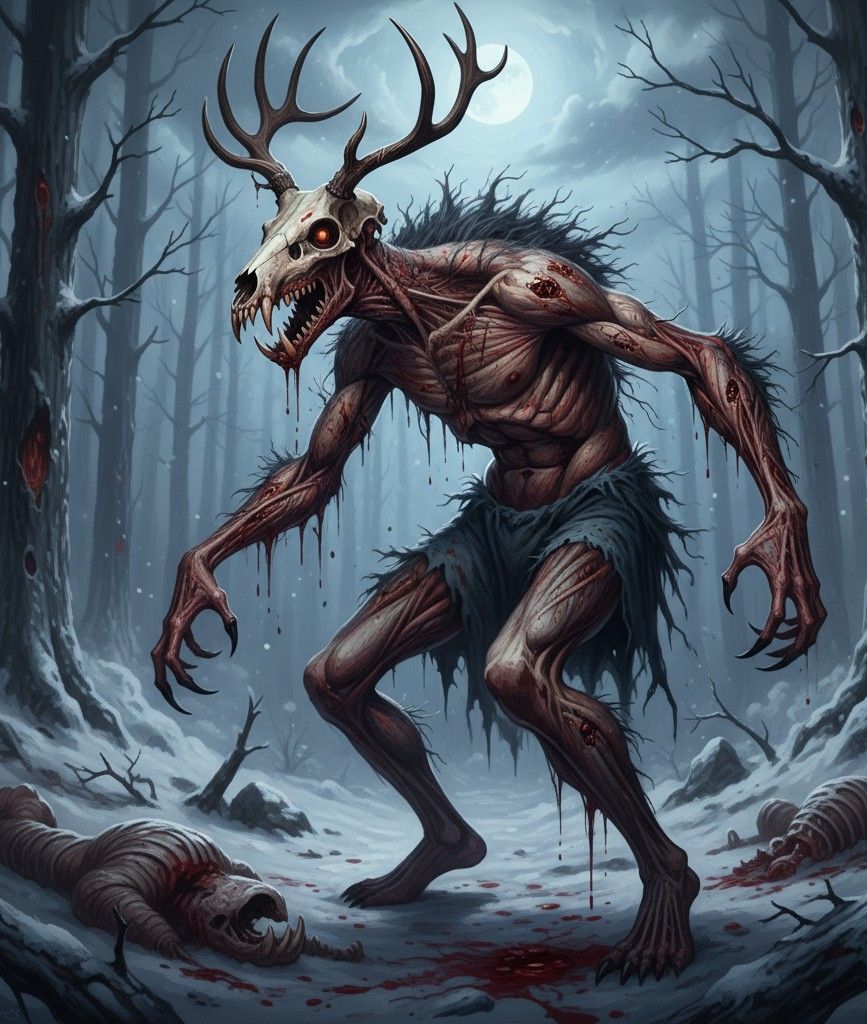
    Trees twisted into shapes that resembled screaming faces. Roots pulsed like veins. The snow was never white anymore—it shimmered with a faint pink stain, as if remembering every spill of blood.

    Kael and Elora lived deep within its corrupted heart, but peace never came.

    Every day, Kael grew weaker. Every night, the curse grew stronger.

    His skin split open unpredictably, exposing raw red muscle that trembled in the cold. Sometimes his spine would tear from his back, reshaping into antlers before retracting again. His ribs snapped and reset beneath his skin, each break echoing through the forest like brittle bone chimes.

    Elora healed him again and again—stitching flesh with magic, regrowing tissue with whispered spells—but her power was fading. Dark circles bruised her eyes. Her hands shook constantly.

    She knew magic could not win a war against hunger.

    And the forest knew it too.


    One night, they heard the hunters before they saw them.

    Not a small band like before—
    An army.

    Dozens of torches glowed between the trees, cutting through the dark like a thousand burning eyes. The villagers had finally united. Witches and monsters were to be cleansed. Purified. Destroyed.

    Elora’s breath caught. “Kael… we have to run.”

    But he was already on the ground, body convulsing violently. His arms split open at the elbows, bone bursting through like jagged blades. A scream tore out of him—raw, animal, agonizing.

    “Elora…” he gasped, his voice wet with blood, “I can’t… hold it back.”

    She knelt beside him, glowing hands hovering over his torn flesh.
    “I won’t let you turn again. I won’t lose you.”

    He grabbed her wrist. Hard. Too hard.

    “Elora,” he rasped. “If I turn… I’ll kill you.”

    “I don’t care!”

    “You should,” he bared his teeth, “because I won’t be able to stop myself.”

    His jaw cracked, angling into something inhuman. Elora felt his pulse—rapid, frantic, hollow.

    The wendigo was seconds from breaking free.

    And the hunters were almost upon them.


    The first arrow struck Elora in the shoulder.

    She didn’t scream, but Kael did—an ear-splitting howl that rattled the branches and sent birds exploding from the treetops. His partially formed antlers tore through his scalp, blood streaming down his face like red tears.

    More arrows flew. One sliced across his side, another embedded in his leg.

    The forest went silent.

    Then it woke.

    Roots erupted from the ground, skewering hunters like meat on hooks. Blood splattered against the trees. Limbs tore free. Screams rose and were swallowed by the soil itself.

    But there were too many.

    Torches closed in.

    Arrows rained down.

    And in the center of it all, Kael snapped.

    His human form dissolved—skin peeling away like wet parchment, muscles tearing open as a skeletal frame emerged beneath. His jaw unhinged wider than any creature should allow. Ribs splayed outward like a cage of knives. His eyes burned with that hollow, endless white.

    He became wendigo.

    Fully.

    Horribly.

    Beautifully monstrous.

    And he attacked.

    He tore through hunters with a ferocity he’d never unleashed before—spines ripped out in a single motion, skulls crushed, bodies ripped in half. Blood painted the trees in thick dark streaks. The ground churned with organs and shattered bone.

    But with every kill, the curse tightened its grip.

    With every kill, the man inside faded.

    “Kael!” Elora screamed, staggering through the carnage, blood soaking her dress. “Please! Come back!”

    The wendigo turned toward her.

    And for the first time…

    He didn’t recognize her.

    He charged.

    Elora raised a shaking hand. “Kael, STOP!”

    But the creature slammed into her, pinning her to a tree. Its claws wrapped around her throat, cold and trembling with hunger.

    “Elora…” His voice flickered inside the monster’s snarling breath. “Run…”

    But she didn’t.

    She touched his face—his monstrous, bone-split, blood-drenched face—with gentle fingers.

    “I love you,” she whispered, voice breaking. “Enough to end you.”

    A spell ignited in her palm—pure white fire. The same spell that had once saved him.

    Kael’s eyes widened.

    “No… Elora…”

    “It’s the only way.”

    She pressed her burning hand to his chest.

    The wendigo shrieked, body twisting, flesh melting, bones cracking as the curse burned. He tried to pull away, but she held him tighter, even as the flames scorched her skin.

    “Elora!” he choked, the human voice rising for the first time. “Please—stop— it hurts—”

    “I know,” she sobbed, tears falling onto his burning ribs. “I’m sorry. I’m so sorry.”

    The wendigo’s antlers crumbled to ash.

    His claws shrank.

    His bones collapsed inward.

    And Kael—just Kael—fell into her arms, shivering, small, human… dying.

    She lowered him gently to the blood-soaked snow.

    His breathing was shallow. His eyes glassy. Smoke rose from his torn chest.

    “Elora…” he whispered weakly, “Did… I hurt you?”

    “Never,” she said, stroking his hair. “You saved me. Every day.”

    His lips trembled.
    “I didn’t want… to leave you alone.”

    She pressed her forehead to his.
    “You won’t.”

    His eyes flickered shut.

    His heartbeat stopped.

    The forest went quiet.

    Elora kissed his cold cheek. Then, with shaking hands, she drew a dagger of bone and sliced her own palm open.

    “My life for yours,” she whispered, letting her blood drip onto his chest. “Take whatever I have left.”

    The forest listened.

    It always listened.

    And this time… it refused.

    Her magic sparked. Then fizzled.
    Her blood steamed. Then froze.
    Her heartbeat slowed.

    Elora collapsed beside him, her fingers entwined with his.

    And the Blackpine Forest swallowed their bodies gently—roots curling around them like mourning arms—two souls tangled together even in death.

    Some say the forest mourned for a century.

    Others say, on winter nights, you can hear two voices whispering in the wind:

    “I love you.”
    “I’m sorry.”
    “I remember.”

    But most terrifying of all…

    Some say the forest now hungers in their place.

    The End.

  • The Blackpine Forest should have been their refuge.
    But some places remember monsters too well.

    Elora and the newly-human wendigo—now calling himself Kael—hid in the deep woods where the trees grew tight as ribs. She built a shelter of roots and charms, a place where the world couldn’t find them. But magic cannot cure everything.

    Especially hunger.

    Kael’s body was human, but the wendigo’s curse clung to him like a shadow clinging to bone. At night, he shook with cold, his teeth chattering, breath steaming like a dying beast. Elora held him until dawn, whispering spells meant to soothe, but each morning he woke thinner.

    And hungrier.

    The forest felt it too. Animals fled long before they saw him. Crows perched above them, staring, waiting. Even the bark on the trees grew black and veined, as though rotting from the inside.

    “Something’s wrong,” Elora whispered one night as Kael convulsed, clutching his ribs. “Your soul is fighting your body. It wants to go back.”

    He groaned—something wet snapping beneath his skin.

    Then came the scream.


    The hunters returned before dawn, guided by blood hounds and the promise of coin. They found the forest unnaturally silent, the snow blackened as if burned.

    The first hunter stepped forward.

    A shape dropped from the branches above.

    Not quite man.
    Not quite wendigo.
    Something stuck in the transformation—flesh splitting, bones jutting, skin torn as if the human body refused to contain what lived inside.

    Kael tore the man open with jagged claws made from half-formed bone. The sound was wet and sharp—like branches breaking inside a body. Blood sprayed across the snow, steaming in the cold.

    The others screamed, but the forest swallowed the noise.

    Kael moved too fast. Too hungry. He ripped them apart one by one—skulls crushed, limbs twisted, chests torn open like rotten fruit. The snow turned crimson, soaking up everything he had refused to become.

    Elora burst into the clearing just in time to see him devouring the last hunter, jaw unhinged wider than a human’s should. Blood dripped down his chin. His eyes glowed that pale, starving white.

    “Kael,” she whispered, horror and heartbreak cracking her voice. “Stop.”

    He froze.

    Her voice—the only thing that had ever reached him—echoed through his twisted veins. He crawled backward, gagging on the blood in his mouth, shaking his head violently as if trying to tear the hunger out.

    “Elora… I’m sorry… I—”

    His spine cracked. Ribs split through skin. His body contorted as the wendigo inside clawed for freedom.

    “You’re becoming it again,” she whispered.

    “No,” he snarled through blood-slicked teeth. “I won’t.”

    But the forest disagreed.

    The curse surged. Bones twisted. Muscles tore open, reknitting in monstrous shapes. His face stretched thin, jaw lengthening, teeth sharpening. He fell to his knees, screaming as his human skin peeled away like wet parchment.

    Elora rushed forward, gripping his face between both hands. Her palms glowed with vicious white fire.

    “Then fight it!” she cried. “Fight it or I’ll burn it out of you!”

    “Do it…” he gasped. “Before I hurt you.”

    Her magic scorched his skin. Steam rose where her hands touched him, and he howled—half man, half beast, all agony. The light burned through the curse like acid through bone.

    The forest shook. The trees bent away. The crows scattered like ash.

    When the light finally died, Kael collapsed in her arms—bloody, trembling, human again… just barely.

    Elora held him, sobbing into his hair, her tears streaking through the blood on his skin.

    “I can’t lose you,” she whispered.

    “You won’t,” he rasped. “But you must know something…”

    She lifted her head.

    “The more hunters die, the more they’ll come,” he said weakly. “And now they know what I am.”

    Elora’s eyes hardened—not with fear, but fury.

    “Then let them come,” she said. “I’ll show them what a witch in love with a monster can do.”

    Kael’s smile was faint, broken, but real.

    High above them, the trees rustled.

    Something ancient stirred.

    Something older even than the wendigo curse.

    Blackpine Forest had accepted their blood.

    And it wanted more.

  • The villagers whispered that the Blackpine Forest was cursed, but they didn’t know the truth. They didn’t know that something ancient watched them from the shadows—something hollow-eyed, bone-thin, and hungry.

    A wendigo.

    For centuries, it prowled the pines, driven by the endless craving for flesh. Its ribs pressed through its skin like jagged branches, its breath a cold hiss that carried on the wind. Nothing had ever softened it. Nothing had ever stirred its dead heart.

    Until her.

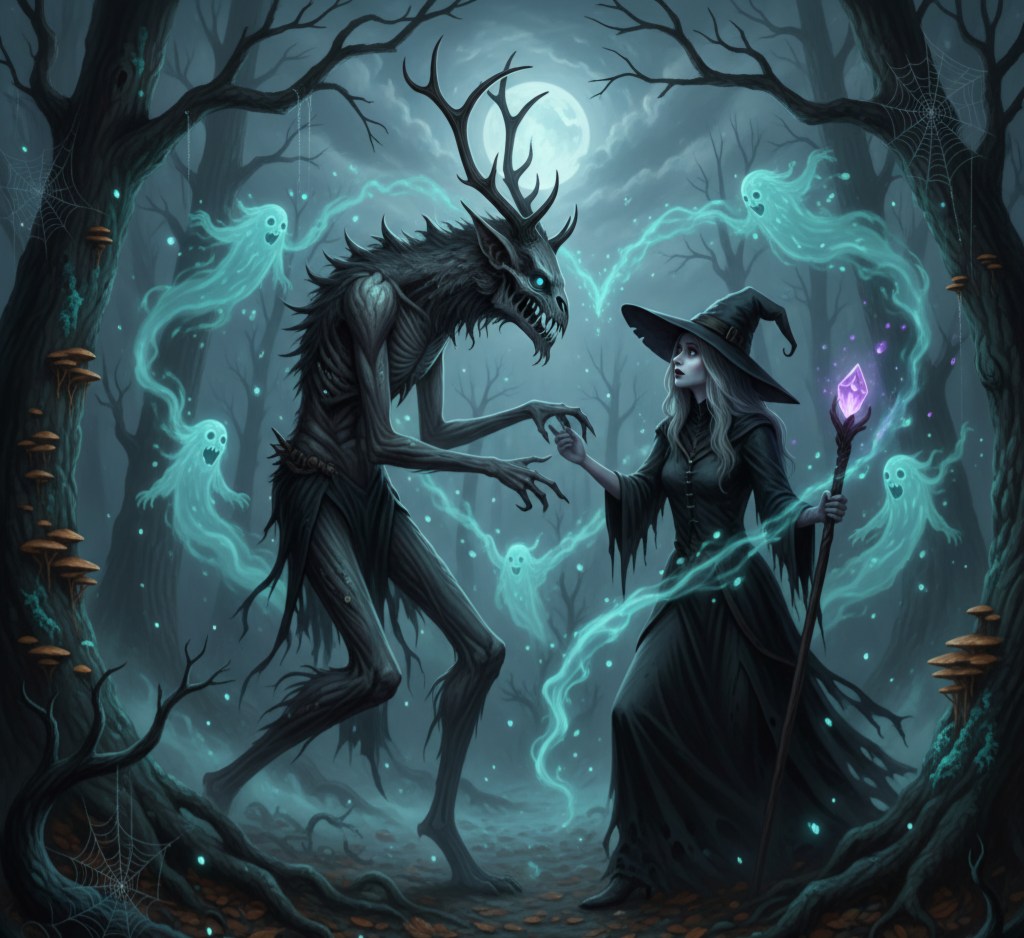
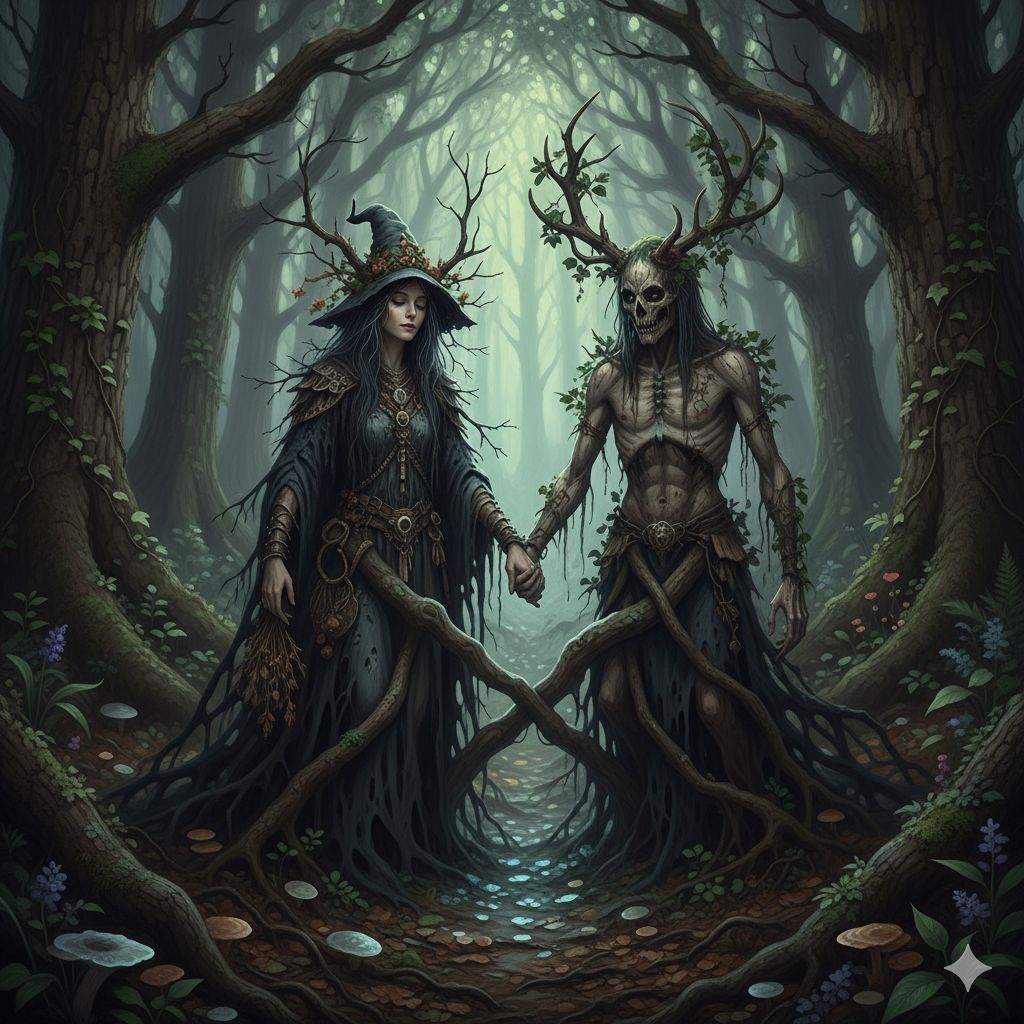
    She came at dusk, the witch with moonlight tangled in her hair and a lantern glowing green at her hip. She walked the forest as if the darkness bent away for her. The spirits whispered her name: Elora. Mortals feared her, but the wendigo watched with something strangely close to fascination.

    Elora spoke kindly to the moss, soothed snarling beasts with a glance, and sang lullabies to restless ghosts. Her magic threaded through the trees like silver threads, softening the shadows.

    The wendigo followed her. At first from afar. Then closer. Close enough to smell her warmth, her life, her beating heart.

    It wanted to devour her.

    It wanted to worship her.

    It didn’t understand the difference.

    One night, the witch stopped on a frozen trail and whispered, “You can come out. I know you’ve been following me.

    ”The creature stepped forward, towering above her, its antlers scraping the branches. But she didn’t scream. She looked into its sunken eyes as if she saw the remnants of the man it once had been.

    “You’re lonely,” she said softly.

    No one had spoken to it in centuries. No one had seen it.

    And so, the wendigo returned to her, again and again. He brought her offerings—broken branches, feathers, skulls polished by snow. She accepted each one, unafraid. When she touched its hand, frost spread beneath her fingers, but she didn’t pull away.

    A strange bond grew. Quiet. Unnatural. Forbidden.

    But love—especially the twisted kind—invites disaster.

    One night, hunters entered the woods, determined to slay the witch and earn her bounty. Elora sensed them too late.

    When they raised their weapons at her cottage, the wendigo tore from the trees with a roar that cracked the sky. It ripped through the hunters with feral devotion, protecting the only thing it had ever cared for.

    Blood steamed on the snow. The forest fell silent.

    Elora stepped toward him trembling—not with fear, but with sorrow.

    “You’ve doomed yourself,” she whispered.

    “They will never stop hunting you now.”

    The wendigo knelt before her, lowering its monstrous head. For the first time in centuries, it felt grief. And love. And fear… fear of losing her.

    Elora cupped its face. Her magic glowed between her palms—soft, warm, pure.

    “I can change you,” she said. “But it will cost you everything you are.

    ”The wendigo hesitated. Hunger clawed inside him. His monstrous instincts screamed.

    But he looked at her…

    …and chose.

    The forest erupted with blinding light. Bones cracked. Antlers shattered. The scream was part agony, part rebirth.

    When the light faded, a man knelt in the snow—thin, trembling, scarred by centuries of hunger—but human again.

    Elora reached for him.

    Before she could speak, a single whisper drifted from the shadows:

    “Monster…”

    More hunters.

    More torches.

    More hate.

    Elora grabbed his hand. “Run.”

    Together they disappeared into the Blackpine Forest, a witch and the man-who-had-been-a-monster. Some say they still live there, hidden by magic, bound by a love darker and stronger than any spell.

    Others say the wendigo returned—because hunger never truly dies.

    And on certain winter nights, if you stand alone beneath the pines, you might hear a whisper in the wind:

    “Elora…”

    Or worse…

    You might hear her answer.